I’m a Texan. I was born there, grew up there, and some day I’ll come back. More recently, I lived in California. I spent some time in the Antelope Valley, which is about an hour and a half north of Los Angeles. The biggest cities are Palmdale and Lancaster. The crowd there is a bit different than the typical Angeleno or SF type. Many of them want to move to Texas due to the lighter taxes and cost of living, but there’s a problem with that:
California and Texas taxes are similar for homeowners below $200,000/yr of income. This aside, the higher your income is, the more you are taxed in California.
Overview
I’m going to look at three types of taxes: payroll taxes, income taxes, and property taxes. Income taxes are assessed on gross income. Payroll taxes are collected from both employers and deducted from employee wages. Property taxes are collected by local (not state) governments based on the value of real property. To compute property taxes, I sampled a representative property from each state: a condo unit in a high cost of living city, a townhouse in a less expensive city, and a single family home in a suburb.
I will also consider federal income and payroll taxes. Since federal taxes apply to California and Texas in equal rates, I will include them in charts only. It is worth mentioning that the State and Local Tax Deduction (SALT) no longer meaningfully impacts federal taxes, because the SALT deduction limit is lower ($10,000) than the 2024 standard deduction ($14,500).
I will exclude sales taxes, tax deductions, capital gains, or cost of living. I glanced at sales taxes and decided the differences were negligable. For deductions and cost of living, there’s simply too many variables. I indirectly take cost of living into account in the property tax section, but I don’t consider the difference in mortgage payments.
Let’s start the analysis by looking at tax rates for each state.
California Taxes Overview
California collects payroll, personal income, and property taxes. While the employee does not directly pay for employer payroll taxes, they still present a cost for employers. This is why employer payroll taxes depress wages.
California is a high personal income tax state, and a low property tax state because of Proposition 13 (Prop. 13). Prop. 13 is a state constitutional amendment which limits property taxes to a maximum of 1% of the assessed property value, and does not easily allow for re-evaluation of that value. California state and local governments collected approximately $91B from property taxes and approximately $195B from income taxes in 2024.
California Personal Income Taxes (PIT)
California’s Employer’s Guide to Taxation lists the the tax brackets for personal income tax for calendar year 2025, reproduced here for single and married persons:
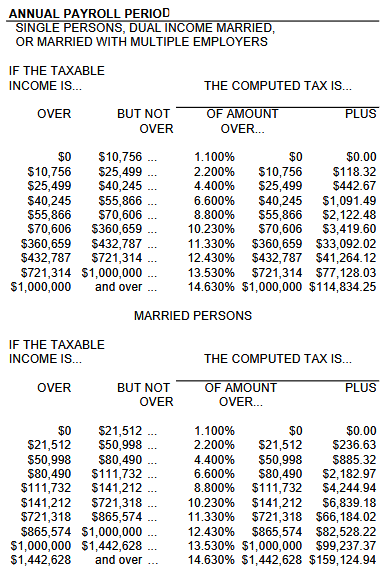
Per table 3 of the guide, California has a standard income tax deduction of $5,540 or $11,080 depending on marital status. This is separate from the standard federal tax deduction, which applied to federal income taxes (see Appendix A).
California Payroll Taxes
Employers in California are required to withhold Unemployment Insurance (UI), and Employee Training Tax (ETT) These are comparatively small, representing a total withholding of approximately $500 per employee per year. The employee funded State Disability Insurance (SDI) is more significant with a 1.2% draw and no cap.
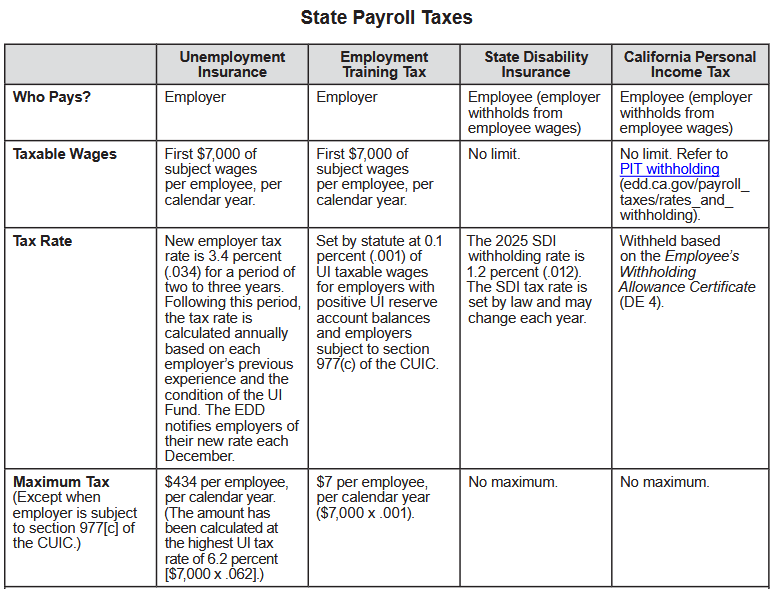
California employment taxes are therefore the sum of the PIT, UI, PTT, and SDI. If we assume the UI tax is the nominal new employer tax rate, this is the result:
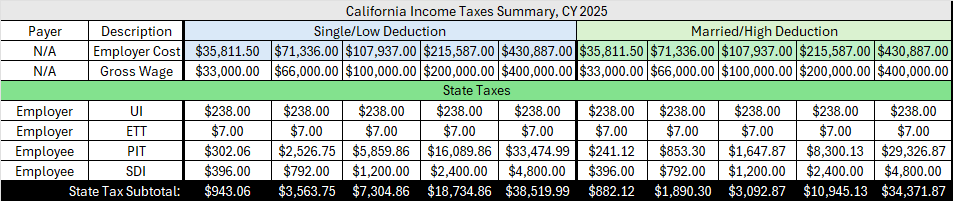
note: See Appendix B for a breakout including federal taxes
California Property Taxes
California has low property taxes, but since the tax is assessed by localities it’s important to look at individual properties.
I selected three properties to look at in California. For the urban selection, a 2/2 condo in San Francisco. For the mid-cost option, a townhome in San Diego. For the suburb, a McMansion in Palmdale. As a homeowner in California, you’ll also benefit from Proposition 13, which will prevent your property taxes from being reassessed so long as you own the property.
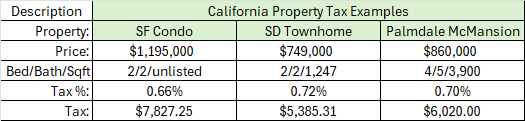
Unlike the income tax section, I lifted the tax rates from the SmarterAsset calculator, rather than digging through individual county records. For our purposes today, A person’s total tax burden is the sum of their income and property taxes.
Throwing it all together
The total state/local taxpayer burden in California is therefore the sum of the above sections. Here’s the matrix of what those costs look like:

Note that some combinations are unaffordable.
Texas Taxes
Texas tax collection is much simpler. For starters, there’s no personal income tax. Payroll taxes are also small. Instead, local governments collect property taxes, which are much higher than California. The properties I sampled have tax rates between 1.6% and 2.1%.
Texas Payroll Taxes
Texas unemployment insurance, called the General Tax Rate (GTR), is the only payroll tax in 2025. Like California UI, Texas GTR only applies to the first $7,000 in wages for 2025 employees.

Tyhe numbers are small.
Texas Property Taxes
Property taxes in Texas are collected by local governments and vary across the state. However, they are substantially higher than property taxes in California. I selected three properties in Texas to review. I looked at a condo in Austin, a townhome in Houston, and a McMansion in Sugar Land.
For those unfamiliar with Texas geography, Austin is a tech, medical, and academic hub in central Texas with the highest real estate prices in the state. Houston is America’s sprawling fourth largest city with a moderate cost of living. Sugar Land is a commuter town in the southwest section of greater Houston.
Here’s the results for what you can expect to pay for each of these properties in 2025:
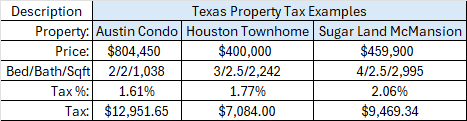
Not only are these figures much higher than the equivalent properties in California, but your taxes will go up every year in conjunction with property appreciation. This is a good thing for effective land use but that’s a topic for another time.
Total Texas Taxes
Like California, I’m calling Texas taxes are the sum of income, payroll, and property taxes. But since Texas doesn’t collect personal income tax, and payroll taxes are small, this is mostly property taxes.

The Delta
Now that we have a sampling of incomes and properties for both states, we can compare taxes in both places. The chart below shows the dollar difference in taxes for each scenario. The property comparison is based on size and location approximations, not sales price, and I’m only looking at the cost of the taxes, not the mortgage, insurance, or other costs. Red numbers are higher taxes in California:

Conclusion
We saw above that the tax situation for California and Texas is quite similar. So, if you’re thinking about moving to Texas just for the tax benefit it’s not the right thing to do. In reality, you’ll need to consider the weight of your offer in Texas before you decide to move there. The same wage will unambiguously go further in Texas, but the details of one offer versus another will be a binary choice made in-situ.
I believe that relocating for competitive offers is the most important thing in building a career. Offers that drive decisions that more than the taxes. Lastly, life isn’t an optimization function; you’ve got to do what’s right for your whole life. Personally I’d be quite happy if I never stepped foot in California again, but that’s not how the world works.
-MCW
Appendix A: Federal Taxes Computation
Federal tax brackets must be briefly mentioned as they apply to all states, but because they apply uniformly they are only mentioned for completeness.
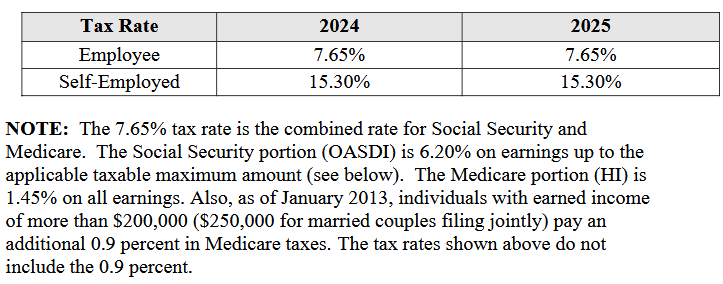
Federal taxes include SSDI, medicare, federal unemployment (payroll taxes) and income taxes. Here’s a summary of payroll taxes:

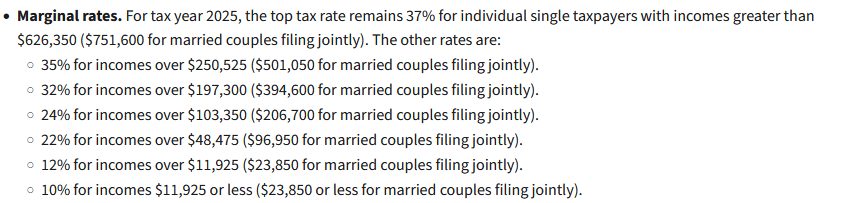
And here are the income taxes for 2025. Recall that income taxes are assessed based on your gross wage:
Put them together, and you get a sense of what federal taxes are like:
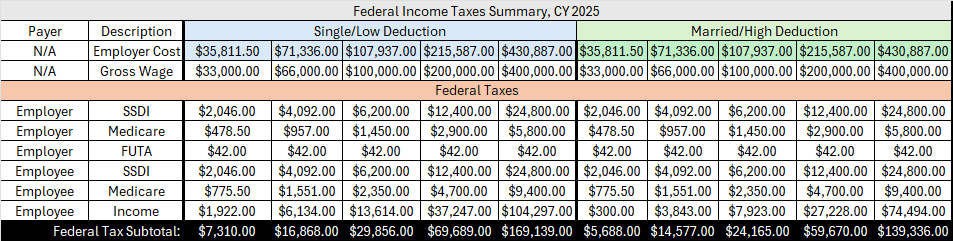
This is much higher than the corresponding state level tax. The kicker is that you’re responsible for paying both the federal and the state taxes together. It’s remarkable that when you combine the federal, state, and local taxes together, about half of employer cost over $200k goes to taxation.
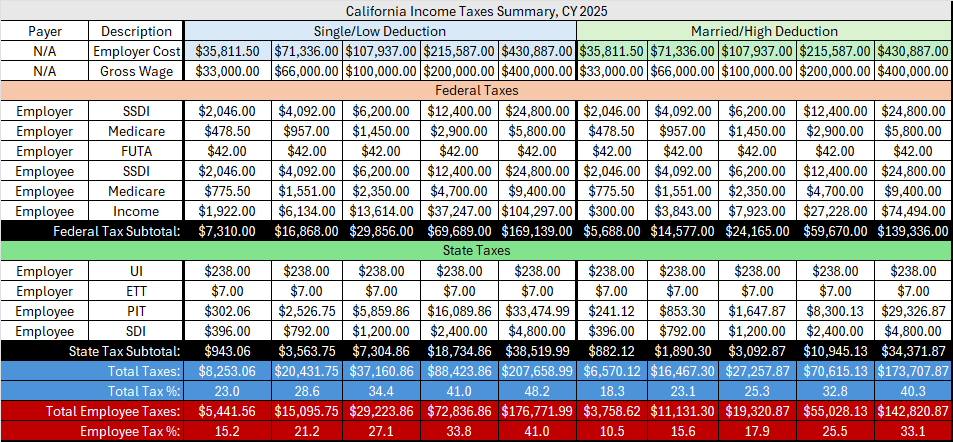
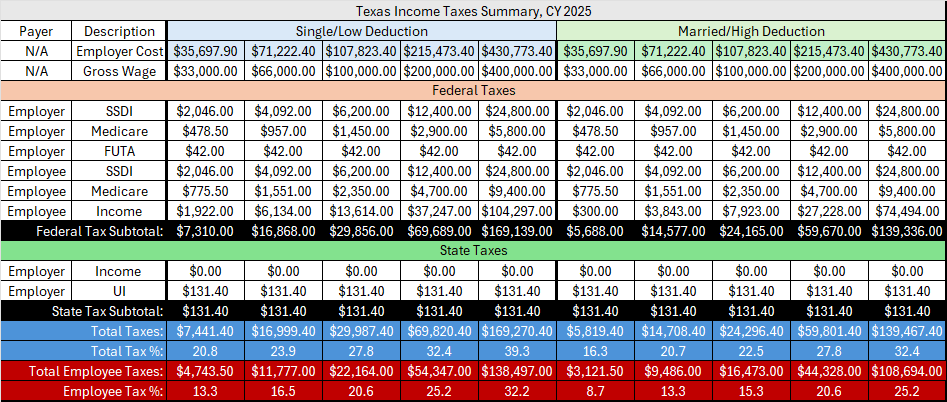
Appendix B: Income Tax Breakdown by State, Federal Included
Notes for this section: tax subtotals, and total tax figures include both employer and employee taxes in their computation. So called “Employee” taxes only include the portion that the employee is directly responsible for paying. Similarly, the percentages are computed based on either the Employer Cost metric or Gross Wage metric depending on the section.
 Mike's Bizarre Adventure
Leave a comment